

There is a kind of coach every athlete eventually meets, regardless of the sport. Soccer. Basketball. Swimming. Track. Wrestling.
The sport changes. The coach does not.
The fair-weather coach loves you when you are performing. He finds you after the big game, hand on the shoulder, building you up in the moments that do not need building. And then the results dip. The slump comes. The bad race, the missed shot, the rough stretch that every athlete at every level in every sport eventually faces.
The hand disappears. The instruction dries up. The conversation gets short. Right when you need it most.
Here is what the research says about what that silence actually costs.
70% of youth athletes quit sports by age 13. Not because the sport got too hard. Not because they lost their talent or their potential. Research across 27 countries and 18 sports confirms that sport participation declines by as much as 80% as children age, increasing until around age 14 before dropping sharply through adolescence. (Source: Youth Sport Dropout Questionnaire Study, MDPI 2025)
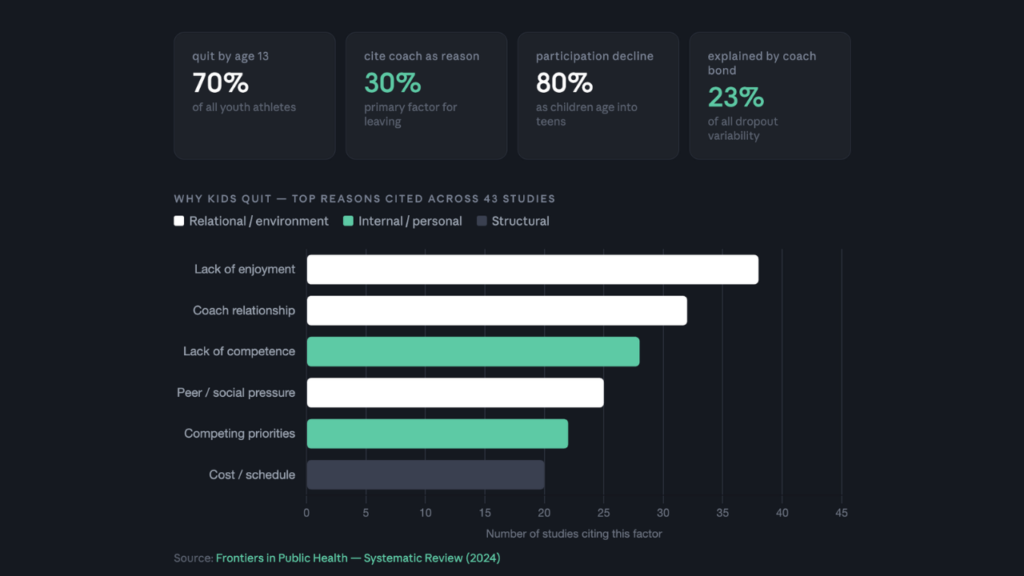
Studies consistently show that psychosocial factors, not physical ones, are the most influential in determining whether a young person continues or stops participating in sport. They are not leaving because the sport got too hard. They are leaving because the environment around the sport stopped being worth it. (Source: Determining Factors of Sports Dropout, Frontiers in Sports 2024)
A 2023 prospective study found that experiencing less autonomy support from the coach was one of the strongest independent risk factors for dropout across youth sport, regardless of the athlete’s skill level or intrinsic motivation. 30% of youth athletes specifically cite the negative actions of coaches as their primary reason for leaving. Not injuries. Not competing priorities. The coach. (Source: Psychosocial Predictors of Dropout, PubMed 2023)
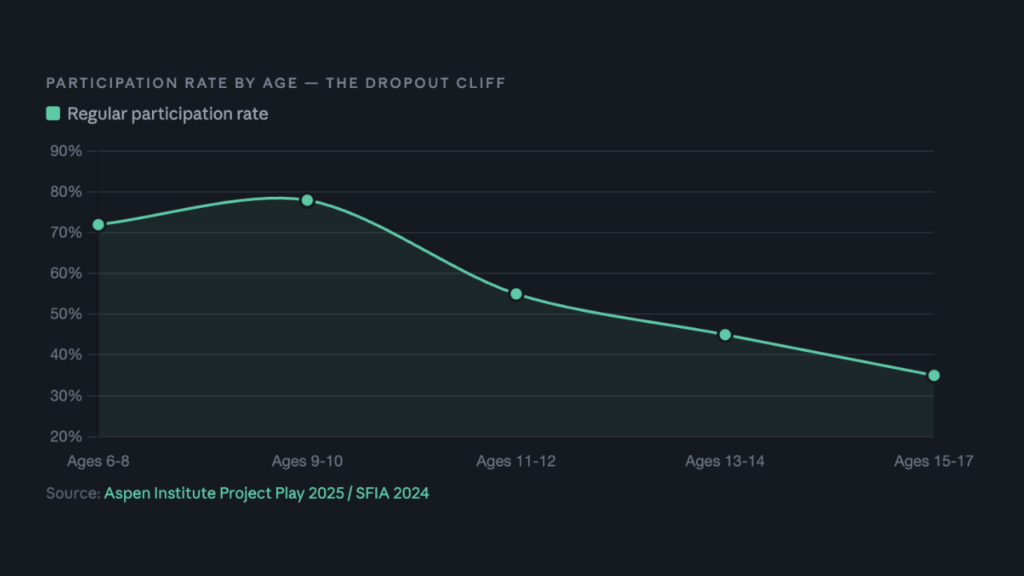
A 2024 cross-sectional analysis of 6,774 young athletes confirmed that while a supportive and motivating coach can encourage persistence, unrealistic expectations or a hostile climate can turn young people away from the sporting environment entirely. (Source: Sports Dropout Ages 8-13, Frontiers in Sports 2024)
Perhaps the most striking finding of all: a longitudinal study found that the coach-athlete working alliance alone explained 23% of the variability in whether an athlete dropped out of their sport, making it one of the single strongest individual predictors of long-term participation ever measured. (Source: Coach-Athlete Relationship and Dropout, PMC 2023)
23%. One relationship. One coach. That much influence over whether a young athlete stays or goes.
The fair-weather coach does not understand that the slump, the rough stretch, the difficult season, is where the athlete is actually built. The kid who is grinding through it, still showing up, still competing, still giving everything they have, is doing something harder and more important than anything they did during the good stretch.
That silence from the coach is not a reflection of the athlete’s ability. It is a reflection of the coach’s.
A systematic review and meta-analysis published in Frontiers in Psychology confirmed that coach support was one of the most consistent predictors of whether young athletes stayed in sport, with the quality of the coach-athlete relationship directly shaping motivation, enjoyment, and long-term participation behavior across every sport studied. (Source: Predictors of Persistent Participation in Youth Sport, Frontiers in Psychology 2022)
Every athlete, in every sport, at every level, wants the same thing. They want to get better. They want to compete without a voice in their head second-guessing every decision. They want to look toward the bench and see someone who believes they can figure it out.
It is absolutely, unequivocally impossible for an athlete not to get better when they feel like they have been truly seen.